Ghada From Palestine
Categories: Interview
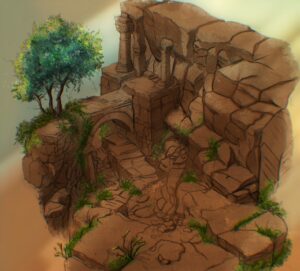
This illustration is created by Ayat, a refugee from Palestine.
Transcript
Fariah: Interviewer, Project Lead for Stories Without Borders
About Ghada
Ghada is a civil engineer and a skilled expert in project management, procurement, and finance, with additional strengths in auditing and reporting. She brings over 15 years of experience working with both national and international organizations. Follow her on LinkedIn.
Interview Transcript
Brief Glossary
There are certain terms and phrases that may be used in this interview that are commonly used by Muslims.
Assalamu Alaikum Wa Rahmatullahi Wa Barakatuhu: May peace, mercy, and blessings of Allah (God) be upon you.
Alhumdulillah: All praise belongs to Allah
InshaAllah: God-Willing
JazakAllah Khair: May Allah reward you well
Du’a: A form of prayer
Beginning of Transcript
Fariah:
Assalamu Alaikum. Peace be upon you. Hello everyone. Welcome to Stories Without Borders, a platform to share the stories of refugees and newcomers in Canada. Today we’ll be interviewing Ghada to learn more about her life experiences.
Ghada is a Palestinian from Gaza and is a talented expert in project management, procurement and finance, in addition to auditing and reporting with over 15 years of experience with both national and international organizations.
Ghada, thank you so much for being with us today. To start, I wanted to ask you what was your experience like living in Canada as a newcomer? What are some barriers you faced and what helped you overcome those barriers?
Ghada:
Salam alaykum everybody and thank you for inviting me for that interview.
My experience living in Canada as a newcomer, as Fariah had told, that my family and I were evacuated from Gaza during the recent conflict and arrived in Canada under the one year temporary resident permit. While I am deeply grateful for the safety and stability that Canada has provided to us, the experience has been both challenging and transformative for us. Adjusting to new environment, rebuilding my professional and personal life and coping with the emotional impact of the war have required resilience and adaptation for us.
Despite the uncertainty of my temporary status, I am committed to contribute positively to my community here, to my community in Palestine and to Canada and I hope for the opportunity to continue building a stable future for us, for me, and for my husband and my kids and adults here where I can apply my skills and experience that I gained in my original country to make a meaningful difference here in Canada for me and myself.
Regarding the other question which is what is the barrier that I faced and what helped me to overcome these barriers? So it is a long story. As a newcomer evacuated from Gaza, I faced several significant barriers while trying to rebuild my life and my family life in Canada.
One of the main challenges was finding stable employment for more than one year and half nearly I was unable to secure work that matched my qualification and experience as an engineer and as a program manager and management. Eventually I accepted lower level job to support my family. This happened when I had a work permit but when it is finished I couldn’t continue because of my political situation and policy.
One of the main challenges was finding stable employment for me and my husband as well as so I accepted low level job to support my family. This happened when I had work permit but when it is finished and I couldn’t renew or extend my work permit for more than five or six months till now. Until now I didn’t get the new work permit for to continue work or to start new work.
So I stopped my work which is low level job now and waiting the new temporary resident permit which will give us give me a chance to extend my work permit. And this caused for me and for my family major difficulties to cover the basic needs for my family and for me.
And also we lose our health insurance and coverage. In addition to this we couldn’t, for me and my daughter I got an admission from the university but I couldn’t start my master’s in management and my daughter couldn’t start her master’s in pharmacy because we didn’t have, we didn’t get the study permit which relies on the extension of the temporary resident permit. So we are now stuck and stopped. We couldn’t do anything. This is the first challenge.
The second one is housing and the living cost which is very high comparing with the prices in Palestine or Gaza for example. So the high price of renting, transportation, the food consumed our saving of money that we bring with us from Gaza and which led us to sell our house in Gaza and our car in order to cover the expenses here in Canada. So also my children faces a lot of difficulties in school because the administration requests a lot and repeatedly their new documents in order to be stable in their education in school.
So as I told you regarding the study permit and everything like this and in addition to that our credits or our certificate as civil engineer for example, I couldn’t work as engineer because I have to equivalent my certificate and I start this process. But I stopped now because my temporary resident permit are expired and they couldn’t continue equivalent my credit till I got new documents.
These are some of the challenges that we faced in the beginning and still facing till now.
Fariah:
Thank you very much for sharing, Ghada. It’s very important for us to learn about your experiences.
My next question is how did your faith support you during your experience?
Ghada:
Of course our faith guided us to remain calm, compensate and determined to rebuild our life with dignity. So it encouraged us to support each other. Each one of the family are supporting each other. So if I feel frustrated or if I was sad, so my husband support me with his words, his hope and his belief in future because we are good persons and we had a lot of experience and skills and one day we will, we will give the chance, we will take the chance and have the chance to succeed here in Canada and find a suitable job and dignity life for me and my family.
So and in addition to that there is some friends here who helped us to overcome the bad situation and the hard condition because there is also another families from Gaza coming together with us and we are facing together the same challenges.
So we are encouraging each other, we are supporting each other and start to think how to adapt in this country, how to gain Canadian experience, how to make connections which helps us to overcome all of these challenges.
In addition to this, there is national communities for newcomers which helped, but it was not enough. So the main challenges that we are facing with this community, community centers or community organization for the newcomers that they are also dealing with the newcomers if they got PR. So I was wondering how I am a newcomer and how can I get PR. So they will not help us except we got PR. So the in order to get PR you have to stay here more than three years. So suppose the person who stayed for three years here in Canada, he’s not a newcomer. The newcomer is the one who came here during maximum last year, something like this.
So in order to gain services especially in English and language barrier how they are supporting us in English. So you are not allowed to take that sessions. So we were lucky, the persons or the educated person from Gaza because we were able to talk English, to communicate with the persons or the community, because we are well educated and can talk English, can communicate, can overcome these barriers. But some of the people who are newcomers and didn’t know anything about English, they are suffering more than us.
That’s why even us from who are coming from Gaza, we are studying English in our schools and our university. So we study English, in study our specialization in English. But the way of study in English is different than communicating and talking with the people in the community, the ordinary community. So it, it is a formal language. So I cannot communicate well with the people in the mall, the people in the street and the people in the school itself. So I cannot continue talking in English all the time, because may some, in some points I didn’t find the correct or the suitable words that express my feelings or my inquiry. So that’s why we are facing some challenges. That’s why we are working on ourselves, make self learning, online training or online session to enhance our English language and overcome this barrier.
Fariah:
Thank you very much for sharing, Ghada. That’s very important information for us to know and you provided a lot of important information for this question, but I was wondering if you wanted to also add anything to it.
The next question would be: what resources are currently missing in Canada that can help us better support refugees and newcomers?
Ghada:
Yes, actually Canada is a big country and a strong one. And they provided a lot of safety and valuable opportunity for refugees and newcomers. And several important resources are still missing to help us as a refugee or as a newcomer to rebuild our lives effectively.
So there is a strong need to shorten the processing time for the IRCC applications. So when we are coming to Canada, as I told you, we got one year temporary residency permit and some people from the same situation, got three years, they are still in safe side, but when the period is almost finished, they have to renew it. So the processing time to deal with that type of application is very, very long. And also it is not available online. You have to make it on paper and send it by email, by mail. And after long, long time and long communication with the web form or the website of the IRCC and calling their help center, they didn’t open our application for a long time. You know, I applied to extend my temporary resident on February, the first day of February. So it is before, it is expired three and half months. So I thought that before the ending of my temporary resident permit, I will get a new one. But this not happened till now, I didn’t get my new extension of the temporary resident permit. And just before two weeks they confirmed that they got the application and gave me application number only. So how much time should I wait till they got, until they gave us the papers and the documents of extension. And if I can, for me, my husband had PR and he could find a job and secure some income for the family.
But for the others, other family who are coming here, they are at the same situation of me. So they couldn’t work, they couldn’t study in university. So they are stuck. So how they will cover their basic needs, their expenses? This is a big question.
So there should be an organization or governmental bodies who can take care of that type of persons who are stuck and couldn’t resume his ordinary life. So if they are decreased or short the processing time for everything and they quickly dealing with that type of application, it will be good. And more than so if they are giving more funds or more budget for the community organization who are dealing with the newcomers, they can work well, they can help us more efficiently.
Especially in increasing our skills and preparing us for the market work here in Canada. So if my certificate is not good and not suitable for the marketplace in Canada, they can give me training, long time training in English or in any, any professional for at least any six months. And when I got this certificate I can work in that sector and start a new career. We don’t mind if we shift our career from engineering to any other career which is suitable and which is requested in the labor market here.
And in addition to that, if there is big organization who are allowed or can help us in housing. Housing in different aspect. So when we came to Canada, we came with a few clothes. So we didn’t have a house. We didn’t have any furniture or any food, anything. So we are starting from scratch to find a house. In order to find house you have to rent. So this is the first step. To rent a house, you have to credit score, they are asking us about credit score, we didn’t have credit score now, we are new. So we had to pay six months in advance for housing which makes an extra load for us. And in addition to this, we have to open a bank account and everything related to the housing. Then we have to buy furniture. So we found a small group of people who are supporting the newcomer. It is an individual effort. So some people helped us in bringing beds, for example, bringing KitchenAids, something like this. But this is not enough. The newcomers need someone, some organization, big and strong who can secure suitable house which is furnished and support us with the basic needs and food. And in addition to make an orientation for us, how to start life here, how to use the transportation, for example, it is totally different from our country. In our country we just walk 10 meters and find a public transportation with, from different aspects. We can use the car, we can use the bus and use Uber, many, many types. But for the transportation here, it is totally different, and the people had to learn how to use this public transportation or other type of transportation.
So the instruction, the information needed, how to, you know, when I wanted to register my school, my kids in school, there is a long application. So if I didn’t know how to fill in the application, I couldn’t be able to register my kids. So I couldn’t find people who are giving me and my family enough information. They didn’t guide us well, how to make the application, how to choose the children, the school, what is the meaning of the designated school, when I should restart my kids? Because the registration here finished in April and we came here in Canada in June, which was the end of the school year. So we are waiting, waiting three months without any school or without anything. But luckily, I find some people who advised me to let my kids to enter and participate in community centers, summer camps, something like this, in order to communicate and forced to talk in English. They are little kids, they didn’t know English well, but they are forced to learn English more than us.
So if there is an organization which is strong even it is public organization or community organization or governmental organization who are supporting the newcomers with housing, with education, with English, English courses and also the vocational training is very, very important.
And in addition to that, there is a lot of public recreation centers. You know that as a newcomer, we couldn’t benefit from this recreation center until we stay one and a half year in Canada. So if I didn’t have PR or citizenship or not living in Canada for one and a half year and got active status like temporary residency permit or work permit, so I couldn’t benefit from this recreation center. And if I got this, it is not free. I had to bring a lot of reports, a lot of taxes, reports, something like this, in order to make an evaluation for our application, after that, if I am eligible or not.
Maybe also we need mental health support and also health support and health insurance. So as newcomers, we didn’t know how we can benefit from the health sector here and if it is paid or not. And we need the medicine. Most of the people who are coming from Gaza and suffering from a lot of problems, even it is physical or mentally, because the things that we are overcome and going through it was totally very, very hard. And we need a lot of time to overcome these problems that are stable in our mind and the images of the war and in food security for us and destroy all the where, anywhere you are in Gaza there is a lot of destroy, a lot of victims, a lot of injured. So we saw a lot of things. So we need a lot of time to overcome these problem.
So also if we got paid on job training and if the community or the government put a percentage for employer to let the newcomer work in their companies, this will support us and give us a chance to invest our skills, and gain new skills and gain new Canadian experience and give us a chance to secure job and secure income for our family. So if all of these efforts coming together so the newcomers will not rely on country and government anymore, especially the Gazan people, the Palestinian people, they are used to work, they are used succeed, they are well educated. So we didn’t like and we don’t like, we are feeling bad if we got any service or any money or any benefit without paying, without working hard. This is what, what we learned from our parents, from our community there in Gaza. We are hard worker, we are learning fast, we are relying on ourselves and our efforts. We are well educated so we will if the country support us well in the first period, we will be a good citizen and practicing in development of the Canadian community and we will be the most people who are supporting the community and make community back. So if I find any person who helped us now, I can help the people in future. This is the things that I wanted to tell you.
Fariah:
Thank you so much, Ghada. This is very important. Thank you so much for sharing your story and all this wisdom that you have, today. Your journey is very inspiring and I appreciate your knowledge and your honesty and insight. I wish you all the best moving forward and I hope your story inspires many others. Thank you so much. JazakMullahu Khairan.
Ghada:
You are welcome. Thank you dear.